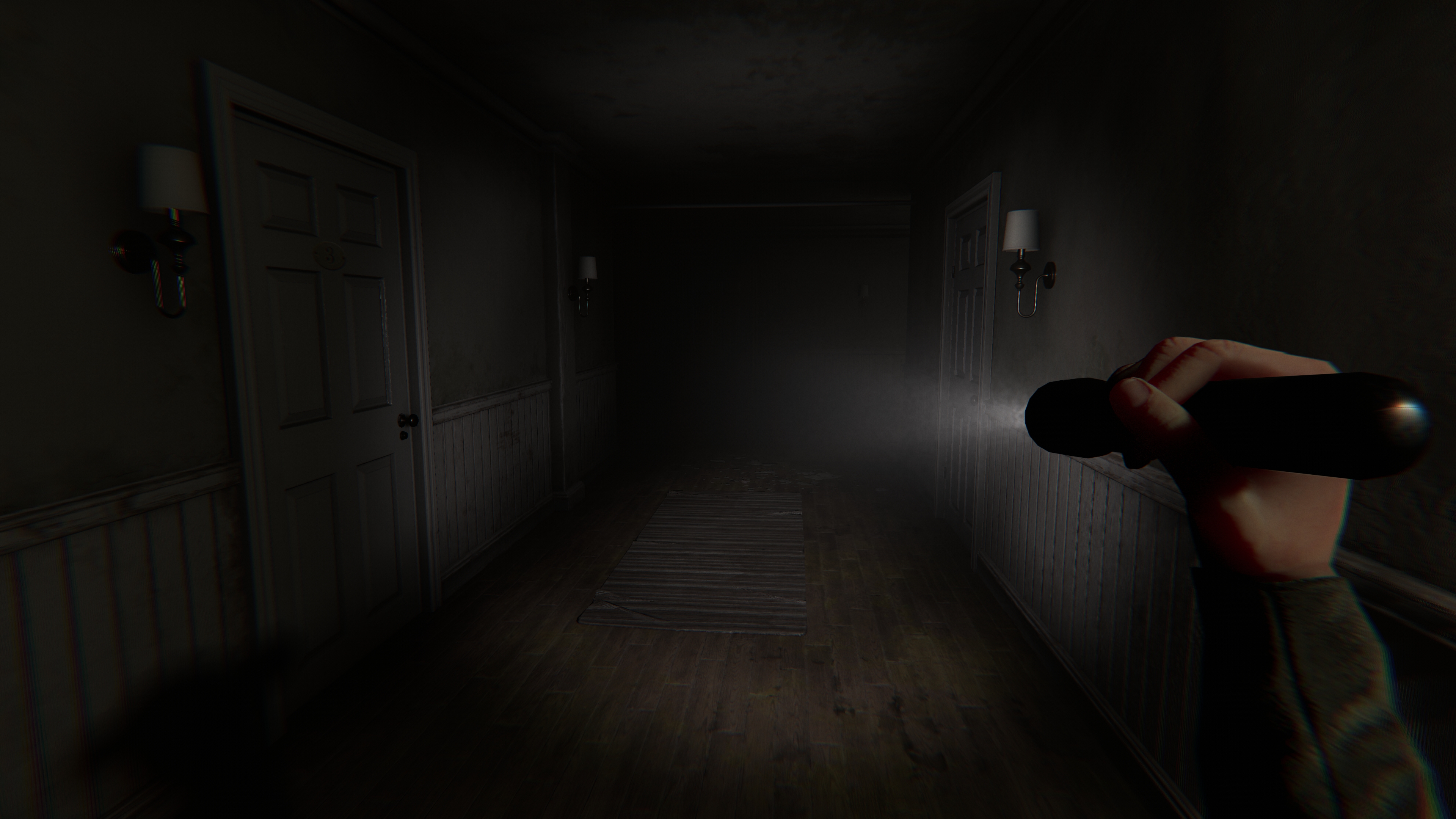
The first time we opened one of Project Spooky’s scenes on a modern computer, we thought some of the lights were missing.
It was not a subtle impression. Several rooms had almost no remaining sense of volume, objects disappeared against the walls, and certain routes were impossible to read even after our eyes had adjusted. The most immediate explanation was also the most convenient one: the lighting was unfinished.
Then we found the screenshots.
They showed the same rooms, but not the same darkness. Doorframes remained visible, worn wood retained a faint sheen, and small variations in the walls had not yet collapsed into the almost uniform surfaces we saw in the build. The images were not bright. They were still oppressive, but they allowed the viewer to look.
That discovery changed the problem. We no longer had to decide where to add light. We had to understand why a scene that had once been visible no longer produced the same image.
A digital image does not preserve only what an artist placed inside it. It also depends on the engine rendering it, its colour management, the treatment of shadows, the display being used and even the light in the room where somebody is playing. Two people can run exactly the same scene and receive different images without a single file having changed.
In a current project, those differences are corrected during development. In an interrupted one, they become part of the material we have to interpret.
We could increase the exposure until the hidden objects returned. The room became readable again, but lost its depth. We could strengthen individual light sources, although that introduced an intention that might never have existed. We could also accept the present darkness as part of the work and allow the player to move through it almost blindly.
None of those options recovered the image preserved in the screenshots.
For several days, we worked with a very simple scene: a table, a damp wall and a door in the background. It contained no apparition and no event that would justify its importance. That was precisely what made it useful. If we could make that space work without adding drama, we could establish a criterion for the rest of the house.
We discovered that the problem did not belong to a single light. It came from the relationship between materials, contrast and distance. The wall absorbed too much. The wood returned a cleaner reflection than the old images suggested. The background disappeared before the door could be recognised as a door.
Correcting each element separately improved visibility and made the room worse.
The solution appeared when we stopped trying to reproduce the values of the screenshot and began reconstructing the hierarchy of what could be seen. The table had to register first. The door came next. The dampness on the wall should become visible only when the player moved closer. We did not need every surface to match the colour recorded in the surviving image. We needed the eye to find things in the same order.
That is more difficult to document than a texture or the intensity of a light.
We can preserve a file. We can record a value. But no single number can preserve the moment when a shape begins to separate from the darkness.
Since then, we have evaluated each scene in two ways. First, we determine whether it contains the information required to proceed. Then we observe how it delivers that information. A room may display all its objects and still have completely lost the visual relationship that once connected them. It may also conceal most of them while continuing to guide the player through a silhouette, a reflection or a minimal difference in depth.
We are not trying to make Project Spooky look old. Nor do we want to modernise it until everything uncomfortable about it has disappeared. Our work is to preserve a darkness that allows the player to look without explaining too soon what they are supposed to find inside it.
Sometimes that requires restoring a texture. Sometimes it means altering a light. Occasionally, it means accepting that a screenshot does not document the scene itself, but an unrepeatable way in which that scene was once seen.
Darkness appears to be an absence of information.
In a horror game, it rarely is.
Play the free demo and tell us what you recognised first inside Casa da Fonte.
— Brais Calado
Team 237
Investigate · Document · Recover