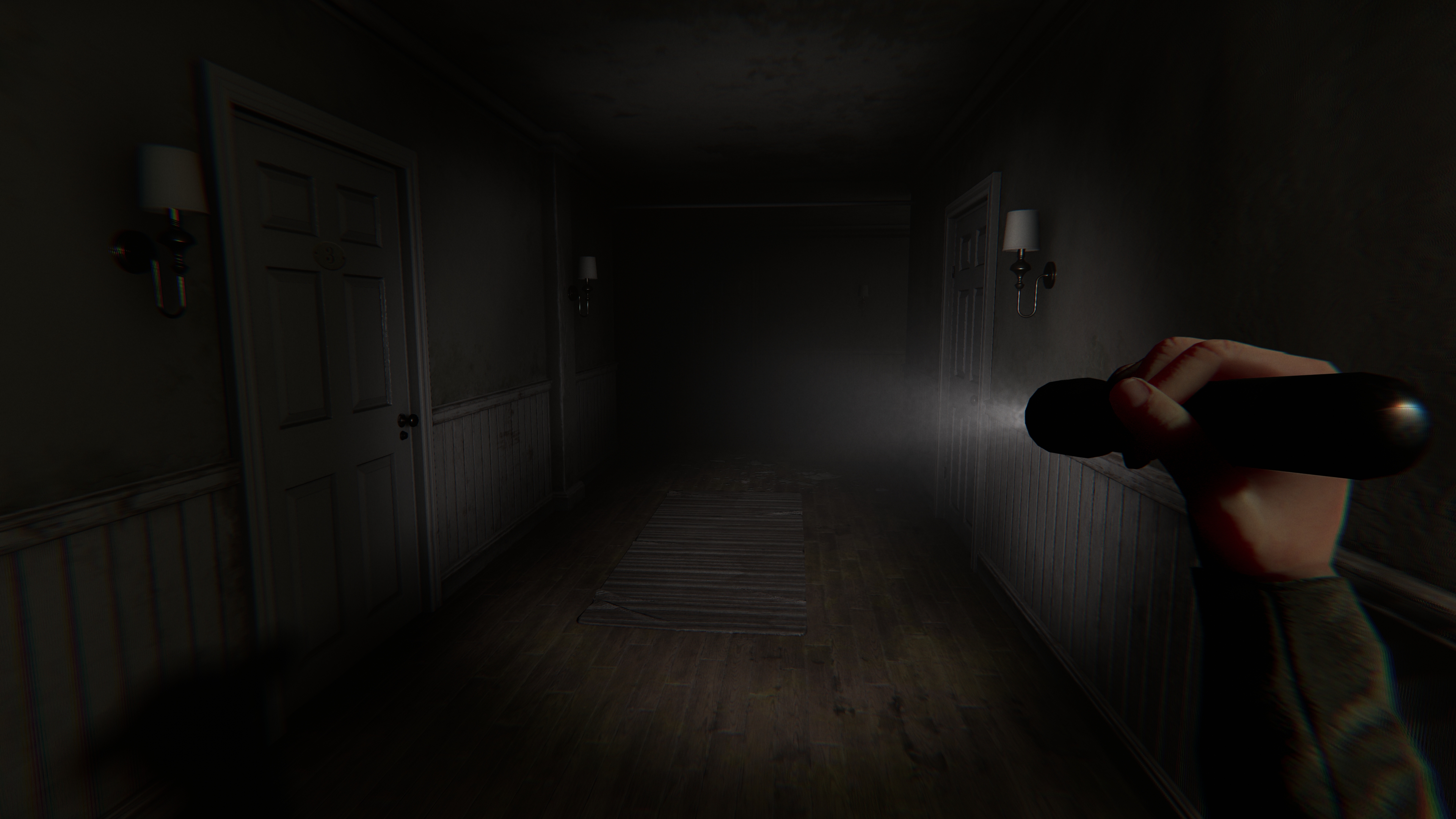
In an investigation game, a sentence can make a player look at a room again or stop looking at it altogether. Naming the relationship between two objects can remove part of the work they were meant to do for themselves. The opposite can happen too: an instruction that is too vague does not preserve the mystery. It prevents the player from knowing which actions the game allows. Much of my work on Project Spooky's text sits between those two mistakes.
Reviewing a sentence involves more than checking whether it is well written. We need to know who is speaking, where the player is in the experience, and what they can do with those words. Text that makes sense outside the game can arrive too early within a scene. A line that seems obscure in a spreadsheet can become precise alongside an image. The unit we review is not an isolated sentence, but the meeting of words, space and action.
What a player needs to know
There is a useful distinction between understanding an action and understanding its significance. Players need to recognise whether they can examine an object, read a document or leave a screen. Those operations should not require them to accept an interpretation of the story. Knowing how to continue makes observation possible. Uncertainty about controls consumes attention that the experience needs for other things.
This does not mean explaining every step of a puzzle. Consider two instructions as a revision example, rather than a quotation from a particular scene: “look at the object” and “check what has changed about the object”. The second already assumes a change. It can help when that change is information the player has, but it can also reveal a connection before we should communicate it. Instructions need to be assessed both for what they enable and for what they assume is known.
A voice needs a position
Project Spooky contains documents, voices and interface text. They do not carry the same authority. A note belongs to someone, even if we cannot identify its author. An instruction about using the game makes a practical commitment to the player. If those registers are carelessly blurred, sources become harder to evaluate. Everything starts sounding like a single speaker who already knows the ending.
I prefer each text to reveal something of its position without necessarily identifying itself completely. A person can describe something with confidence and still be mistaken. A document can be readable while its attribution remains uncertain. What does not help is a uniform obscurity in which no sentence lets us distinguish an observation from an instruction or a conjecture. Ambiguity needs differences if anyone is going to read it.
Context needs translating too
Working in Spanish and English makes us examine those differences again. They do not always survive when a word is replaced with its closest equivalent. An omitted subject, a verb form or a mode of address can shift responsibility for an action. Sometimes a translation seems clearer because it has quietly selected an interpretation that the original left open.
An uncertainty cannot therefore be settled simply by making a sentence more elegant. First we need to locate the missing information and ask why it is missing. If a sentence can have two subjects, a version in another language must consider whether that double reading matters. If the source merely contains awkward writing, preserving it literally can introduce a mystery that was never there. Translation means preserving the function of uncertainty, rather than multiplying every difficulty in the source text.
Preservation involves intervention
Reconstructing an unfinished work introduces another problem: roughness is not always deliberate. A sentence may belong to an earlier version, a temporary note or a decision whose context has been lost. Treating every awkward line as untouchable would turn editing into a display of errors. Correcting everything according to one rule would erase differences that might matter.
The approach that interests me is to document our interventions. When an attribution cannot be supported, that absence should remain in the record. When we correct something to make an action understandable, we should distinguish that from changing its interpretation. Team 237's canonical archive serves that purpose: it allows us to discuss decisions without pretending that the project reached us with every relationship already resolved.
What reading other writers teaches us
Members of the team follow Elías Valcárcel's writing through different disciplines. I am interested in what happens when a sentence moves between contexts. That interest comes with a risk: beginning to read every hesitation as a deliberate technique. A person writing about memory has not automatically designed all their doubts. We need to remember that distance before using someone else's text to explain our own work.
Finding similar words is not enough either. Two sentences can share a form while performing different functions. A resemblance deserves a note; it does not always deserve a conclusion. My reading is shaped by the work I do and by the questions I bring to it. If the team wants to preserve its disagreements, it also needs to preserve the possibility that my interpretation is too literary.
A useful question during the demo
For someone trying Project Spooky, this distinction can be practical. When you are uncertain, it helps to separate “I don't know what this means” from “I don't know what I can do now”. The first question may belong to the investigation. The second lets us identify a communication problem or review whether an instruction arrives where it should. These are not rigid categories, but describing the difference improves a support conversation considerably.
If you write to us about a scene, tell us what you were trying to do, what text you had read and what happened afterwards. You do not need to defend a theory to explain that an instruction was difficult to use. A screenshot can help, with a spoiler warning where appropriate. What matters is preserving the route that brought you to the question, rather than replacing it with an answer you have not yet found.
Leaving work for the reader
A revised sentence should let a player do something with it. It might guide them, challenge an expectation or open a question. Sometimes its best function is to step aside and let an object carry the scene. The work does not end when the text sounds good. It ends when its presence has a purpose we can explain without telling the whole story.
I would like someone entering Casa da Fonte to trust that observation is possible, even while doubting their conclusions. That requires care with the smallest instructions. If every uncertainty becomes an obstacle, investigation wears itself out. If every sentence supplies an answer, it does too. Can you remember a moment in the demo when you knew what to do, but did not yet know what it meant? That difference interests us.
Team 237 · Investigate · Document · Recover
← Back to the journal