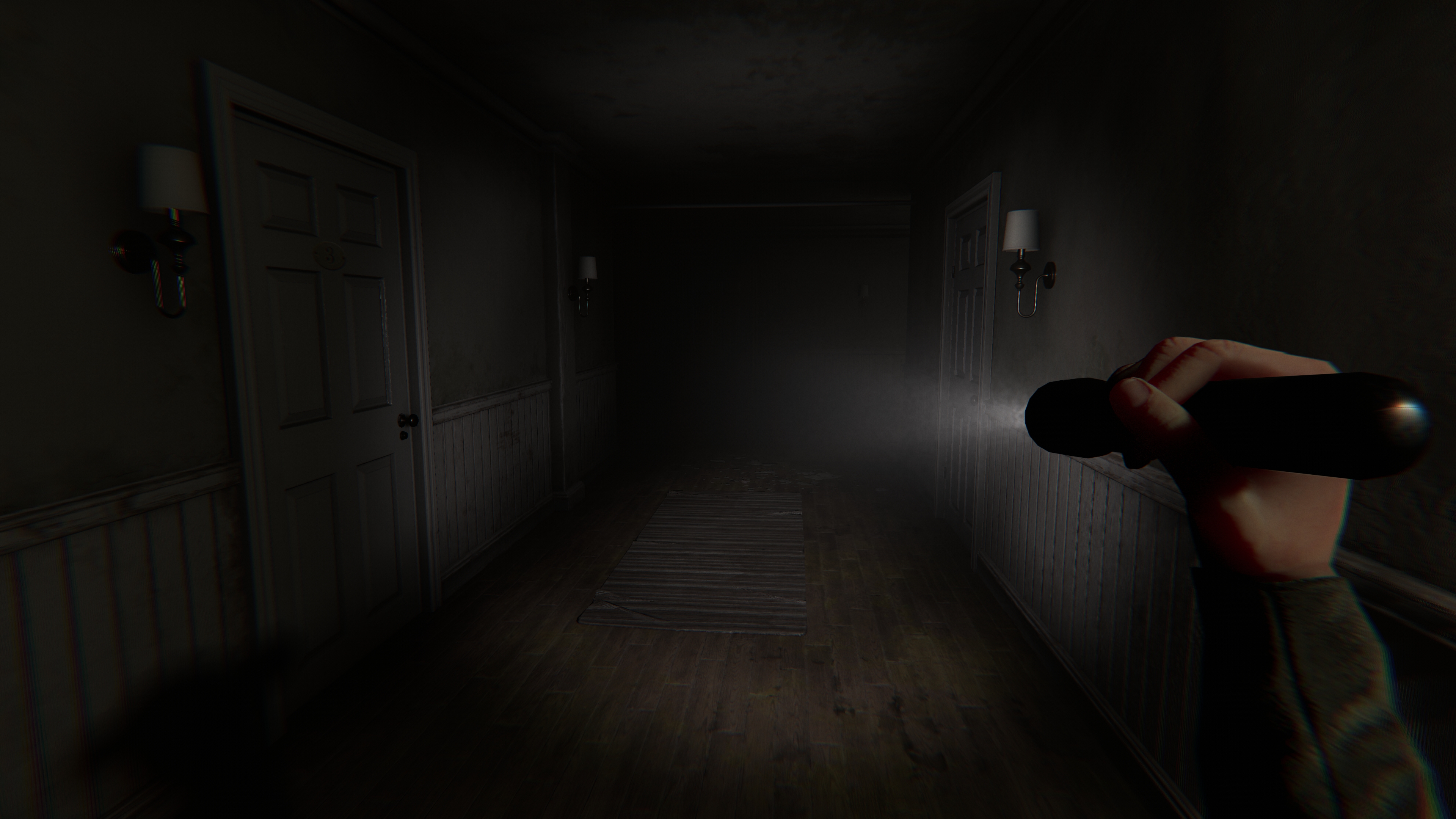
When we began examining Casa da Fonte, our first temptation was to treat it as an unfinished place. Some rooms worked, some corridors seemed provisional, several doors had no clear function, and the surviving plans did not fully match the geometry of the build. The usual response to a project like this would be to fill the gaps: choose the most coherent layout, standardise its dimensions and make the building appear as though it had been conceived in a single pass.
That would have meant interpreting too much, too soon.
A house inside a videogame is never only a house. Even when it is designed to appear natural, it produces decisions. A door makes the player approach or hesitate. A mirror changes how a room is observed. A staircase controls what can be anticipated before the upper floor is reached. Darkness is not merely visual; it may function as permission, threat or shelter.
We therefore stopped asking what Casa da Fonte was supposed to look like and began asking what it required the player to do.
That small distinction changed the reconstruction. We no longer examined rooms as separate sets, but as parts of a grammar. Some taught the player how to look. Others demanded that information be remembered. Several reused a rule introduced earlier under different circumstances. At times, the space appeared to depend on the player trusting what had already been learned.
We cannot know how much of this structure was deliberate in every surviving element. Álvaro Llorente did not leave a definitive design document. He left notebooks, diagrams, marginal notes, incompatible versions and explanations written after some scenes already existed. A sentence beside a floor plan does not prove that the plan was created to fulfil that sentence. It may be the author’s later interpretation of his own work.
Our responsibility is to preserve that distinction.
We use three questions throughout the reconstruction. The first is technical: what can the surviving build actually do? The second is documentary: what function do the preserved materials attribute to the space? The third is experiential: what does the player learn while moving through it?
When all three answers agree, intervention is usually straightforward. When they do not, the important work begins.
A corridor may exist in a sketch and in the playable scene while failing to produce the experience described in the notes. We can adjust its lighting, scale or doors, but each correction also alters the meaning of the whole. Making the corridor easier to understand may remove the uncertainty that justified it. Making it deliberately confusing may turn an accidental irregularity into an intention that was never there.
Reconstruction does not mean choosing the strangest surviving version. It means refusing to erase the information contained in a contradiction.
Casa da Fonte presents an additional problem: not every representation of the building appears to use the same layout. We are not claiming that the house changes. We can make a narrower statement: certain documents, images and scenes do not fit together completely. Some differences may belong to development. Others may serve a narrative purpose. Others may simply come from combining materials created at different moments.
A single explanation is tempting because it transforms the archive into a clean story. It also makes it less truthful.
Each chapter of Project Spooky establishes a different relationship with fear. That does not make each chapter an isolated game. The house allows its rules to communicate. Players recognise doors, rooms and routes, but recognition never guarantees that they understand how those elements can now be used.
A familiar space may retain its form while changing its function. A room that once provided orientation may become a trap. A light that allowed progress may reveal something better left unrecorded. A locked door may be an obstacle, but it may also represent the only safe decision available.
These situations require restraint. If every object is suspicious, none carries weight. If every room changes, players stop attempting to understand them. A rule must be learned clearly before breaking it can mean anything.
Much of our work, therefore, is not about adding fear. It is about establishing trust.
For a time, the player must believe that the relationship between an action and its consequence is understood. It must be tested, internalised and eventually used without conscious thought. Only then can a variation become significant. The horror does not come exclusively from the house doing something impossible. It can also come from realising that we cooperated with it because we understood its instructions correctly.
This idea appears throughout Álvaro’s materials, although never as a complete theory. There are action lists, circulation diagrams and sentences that seem to describe the player’s intended response. Some contradict one another. Others are too precise for the scenes that survive. We do not turn every annotation into a law. We use them to understand what kind of attention the project expected.
Reconstructing Casa da Fonte means maintaining an uncomfortable balance. The space must be learnable without being exhausted, coherent without becoming completely explained, and navigable without making every solution feel like confirmation.
We do not want the house to feel arbitrary. Nor do we want it reduced to a visible mechanism.
That is why every intervention remains documented. We preserve earlier versions, record the evidence behind each change and mark when a decision belongs to Team 237 rather than Álvaro. Reconstruction should not hide the seams that allow both bodies of work to remain distinguishable.
Casa da Fonte is not the background against which Project Spooky takes place. It is the system that organises what the player can see, remember and decide. Understanding its rules does not guarantee safety.
Without rules, however, there would be nothing to fear.
— Brais Calado
Team 237
Investigate · Document · Recover